

Decision Trees#
Decision trees are a class of non-parametric supervised learning algorithms that can be used for both regression and classification. They work by recursively partitioning the predictor space and fitting a simple model (a constant) within each resulting region.
Decision trees are unseful because they are:
intuitive and easy to visualise,
able to model non-linear relationships and interactions,
applicable to both regression and classification tasks.
Tree-based methods segment the feature space into a set of non-overlapping regions (often called boxes). Each region corresponds to a leaf of the tree, and within a leaf the model predicts a single constant value. In regression, the prediciton is the mean; in classification, the prediction is the majority class (or class probabilities).
The regions are (high-dimensional) axis-aligned rectangles. This follows directly from recursive binary splitting, which applies threshold-based splits on single features.
Regression Trees#
The general usage of regression trees is identical to previous regression models (instantiate -> fit -> predict):
from sklearn.tree import DecisionTreeRegressor

model = DecisionTreeRegressor()
model.fit(X_train, y_train)
model.predict(X_test)
A regression tree aims to:
Divide the predictor space into regions \(R_1, \dots, R_J\)
Predict the mean value \(\hat{y}_{R_j}\) for all trining observations in a region \(R_j\)
As you learned in the lecture, there are a few additional parameters which we can choose, such as splitting criteria (where to split) or stopping criteria (when to stop splitting). You can look these up in the documentation.
To see how regression trees perform, we can simply plot the predictions for two different models on synthetic data:
Generate data and split into train/test sets:
import numpy as np
from sklearn.model_selection import train_test_split

rng = np.random.RandomState(1)
X = np.sort(5 * rng.rand(100, 1), axis=0)
y = np.sin(X).ravel()
y[::5] += 3 * (0.5 - rng.rand(20))

X_train, X_test, y_train, y_test = train_test_split(X, y, test_size=0.3, random_state=0)
Fit two decision tree regressors to the data:
from sklearn.tree import DecisionTreeRegressor

model1 = DecisionTreeRegressor(max_depth=2)
model2 = DecisionTreeRegressor(max_depth=6)

model1.fit(X_train, y_train)
model2.fit(X_train, y_train);
Plot the predictions to see how different models behave:
import matplotlib.pyplot as plt

X_range = np.arange(0.0, 5.0, 0.01)[:, np.newaxis]
pred1 = model1.predict(X_range)
pred2 = model2.predict(X_range);

fig, ax = plt.subplots()
ax.scatter(X, y, s=30, c="darkorange", alpha= 0.5, label="data")
ax.plot(X_range, pred1, color="cornflowerblue", label="max_depth=2", linewidth=2)
ax.plot(X_range, pred2, color="yellowgreen", label="max_depth=6", linewidth=2)

ax.set(xlabel="data", ylabel="target", title="Decision Tree Regression")
plt.legend();
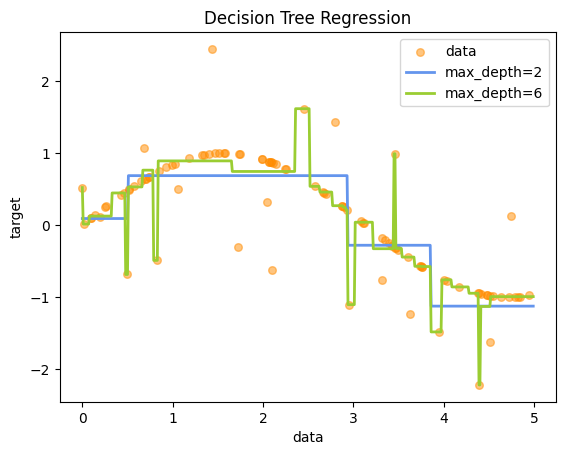
You can see that the model with max_depth=2 model is underfitting, while the model with max_depth=6 is clearly overfitting. We can also can evaluate the models with typical performance metrics such as \(R^2\):
from sklearn.metrics import r2_score

r2_2 = r2_score(y_test, model1.predict(X_test))
r2_6 = r2_score(y_test, model2.predict(X_test))

print(f"R² (max_depth=2): {r2_2:.3f}")
print(f"R² (max_depth=6): {r2_6:.3f}")
R² (max_depth=2): 0.571
R² (max_depth=6): 0.472
The optimisation target#
Regression trees choose splits to minimise within-node squared error. In the classical formulation, this is expressed as minimising the Residual Sum of Squares (RSS) across regions:
Finding the globally optimal partition into \(J\) regions is often computationally infeasible. Instead, trees use recursive binary splitting:
Top-down: start with all observations in a single region
Greedy: at each step, choose the split that gives the largest immediate reduction in RSS
This means at each split, the algorithm selects:
a single feature \(X_k\), and
a cutpoint \(s\),
that minimise the RSS of the two resulting child nodes.
Note: In scikit-learn, the default criterion="squared_error" uses a variance/MSE-based impurity. This is equivalent to RSS because MSE is simply RSS scaled by the number of observations.
Learning break#
Why can’t every possible kind of partition come from recursive binary splitting?
Show solution
Recursive binary splitting produces axis-aligned rectangular regions. Any partition that requires non-rectangular shapes or oblique boundaries cannot be generated by this procedure.Classification Trees#
Classification trees follow the same recursive splitting logic, but use different criteria to evaluate the splits, such as the classification error or purity measures. An popular purity measure is the Gini index, which is calculated as:
A small \(G\) means high purity (mostly one class), while a large \(G\) means low purity, indicating the a split does not split the classes well. Here is an example with the Iris dataset, which contains measurements for three different types of iris flowers:
import matplotlib.pyplot as plt
from sklearn.tree import DecisionTreeClassifier, plot_tree
from sklearn.datasets import load_iris

# Load data
iris = load_iris()
X, y = iris.data, iris.target

clf = DecisionTreeClassifier(max_depth=3)
clf.fit(X, y)

plt.figure(figsize=(12,8))
plot_tree(clf,
          feature_names=iris.feature_names,
          class_names=iris.target_names,
          filled=True, rounded=True, fontsize=14);
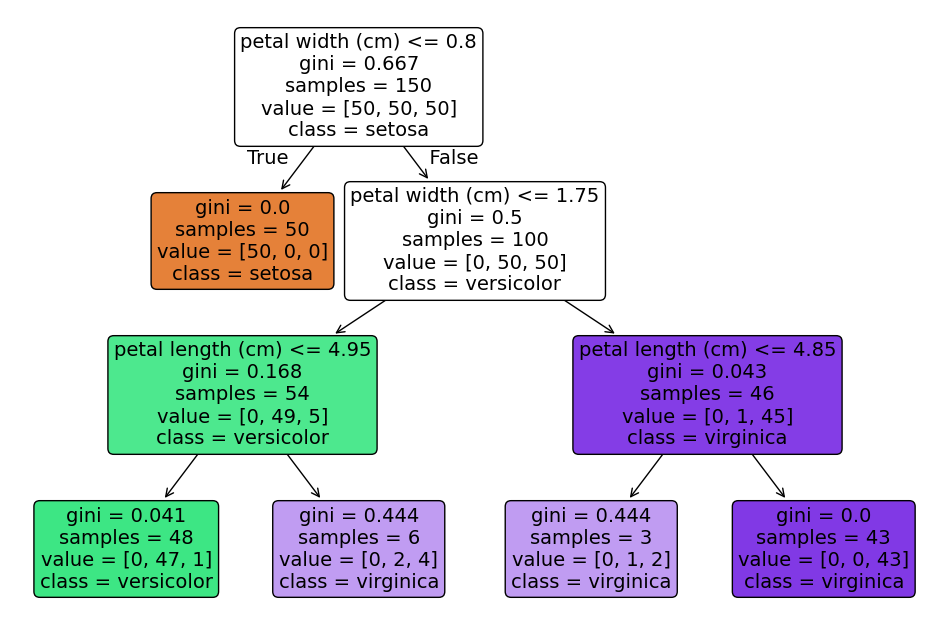
The tree plot of the fitted model contains the following information:
Decision nodes
These are the rectangles with a splitting criterion (e.g.
feature ≤ threshold)They represent the points where the model splits the data and asks “which branch next?”
Leaf nodes
The terminal rectangles without further splits
The leaf nodes mark the final predicted class (
class)
Color fill
The shade corresponds to the majority class at that node
The depth of color indicates purity (dark = almost all one class; light = mixture)
Gini
Determines how pure a node is when choosing splits
The algorithm chooses splits that minimise weighted Gini impurity
Tree depth
The number of levels indicates how many successive decisions are made
Capped by the
max_depthparameter to control complexity
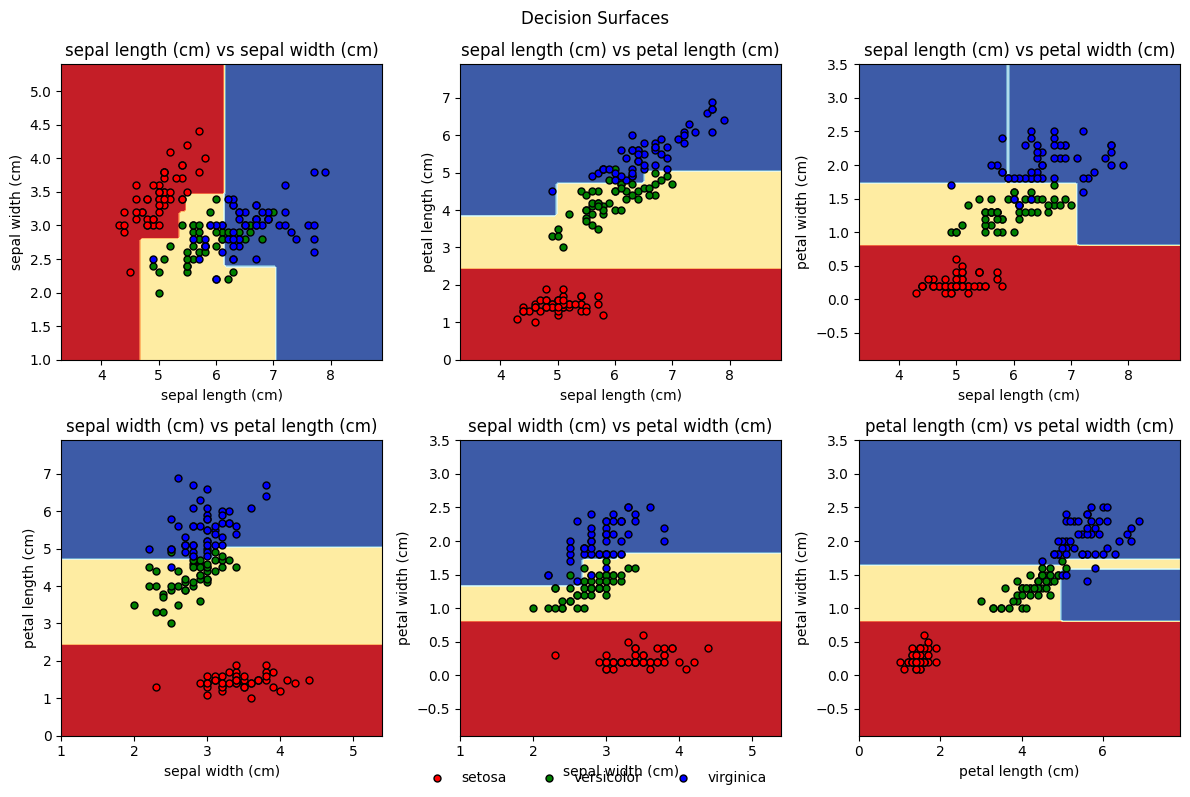
Another nice illustration is plotting the decision boundaries. As this works best with 2 features, we here showcase it for pairwise feature combinations:
Overfitting and Pruning#
Trees are vulnerable to overfitting. If allowed to grow without restriction, they become very deep and fit the training data extremely well. Such trees typically have low bias but high variance, leading to poor generalisation.
To counter this we can do multiple things:
Prune the full-grown tree, also called bottom-up pruning or cost-complexity pruning (we saw this in the lecture)
Tune the hyperparameters that control the tree-growing behavior, also called top-down pruning.
Ensemble methods: bagging, random forests and boosting (will be introduced in the next sections)
Cost Complexity Pruning & Hyperparameter Tuning#
Cost complexity pruning means we add a penalty for tree size such as:
\(\text{Total Cost} = \text{RSS or Classification Error} + \alpha \cdot \text{Tree Size}\)
In scikit-learn this is controlled by ccp_alpha
ccp_alpha = 0-> no pruning (full-grown tree)ccp_alpha > 0-> pruning (smaller tree)
We can further control the tree growing behaviour with hyperparameters such as
max_depthmin_samples_splitmin_samples_leaf
We can use a grid search to find the best combination for some of these hyperparameters:
import numpy as np
from sklearn.tree import DecisionTreeClassifier
from sklearn.model_selection import GridSearchCV

iris = load_iris()
X, y = iris.data, iris.target
X_train, X_test, y_train, y_test = train_test_split(X, y, test_size=0.5, random_state=0)

param_grid = {
    'ccp_alpha':         np.linspace(0.0, 0.2, 10),
    'max_depth':         [2, 4, 6, 8, 10, None],
    'min_samples_split': [2, 5, 10, 20],
    'min_samples_leaf':  [1, 2, 4, 8],
}

grid = GridSearchCV(DecisionTreeClassifier(), param_grid, cv=5)
grid.fit(X_train, y_train)

print("Best params:", grid.best_params_)
print("Test set accuracy:", grid.score(X_test, y_test))
Best params: {'ccp_alpha': np.float64(0.0), 'max_depth': 6, 'min_samples_leaf': 1, 'min_samples_split': 2}
Test set accuracy: 0.96
Ensemble Methods#
Single trees are prone to overfitting and generally are not competetive when compared to more sophisticated models such als support vector machines. Ensemble methods try to solve these issues by combining many trees to reduce variance (bagging, random forest) or bias (boosting).
Bagging (Bootstrap Aggregation)#
Bagging aims to reduce variance by averaging many models trained on different bootstrap samples.
Suppose we train \(B\) trees \(T_1(x), \dots, T_B(x)\), each on its own bootstrap-resampled training set. At prediction time we combine them:
Regression: take the arithmetic mean \(\hat{f}_{\text{bag}}(x)=\frac{1}{B}\sum_{b=1}^{B} T_b(x)\).
Classification: either average the class probabilities and choose the largest, or take a majority vote across the class labels predicted by the trees.
Because the trees are noisy but (approximately) unbiased, averaging drives down variance while leaving the expected prediction roughly unchanged. This is exactly the same intuition as averaging repeated noisy measurements of the same signal.
from sklearn.ensemble import BaggingClassifier
from sklearn.metrics import accuracy_score

bag = BaggingClassifier(n_estimators=200,
                        random_state=0,
                        oob_score=True)
bag.fit(X_train, y_train)
print("OOB score:", bag.oob_score_)
OOB score: 0.9466666666666667
Out-of-bag (OOB) score:
On average, about two-thirds of observations appear in any given bootstrap sample. The remaining one-third are out-of-bag (OOB) for that tree.
For each training observation, predictions are obtained only from trees for which that observation was OOB and then aggregated (majority vote for classification).
The OOB score reports the model’s performance on these OOB predictions. For classification, the default corresponds to the prediciton accuracy, and with enough trees, the OOB score provides a strong internal estimate of test-set performance.
Random Forests#
Random forests improve on bagging by decorrelating the trees. This is done by:
Considering only a random subset of predictors at each split
Drawing a fresh subset at every split
The final prediction still follows the same aggregation rules as bagging (average for regression, majority vote for classification). The extra randomness injected at each split makes the trees less correlated, so the averaging step cancels out even more variance than plain bagging.
from sklearn.ensemble import RandomForestClassifier

rf = RandomForestClassifier(n_estimators=100, random_state=0)
rf.fit(X_train, y_train)

accuracy_score(y_test, rf.predict(X_test))
0.9333333333333333
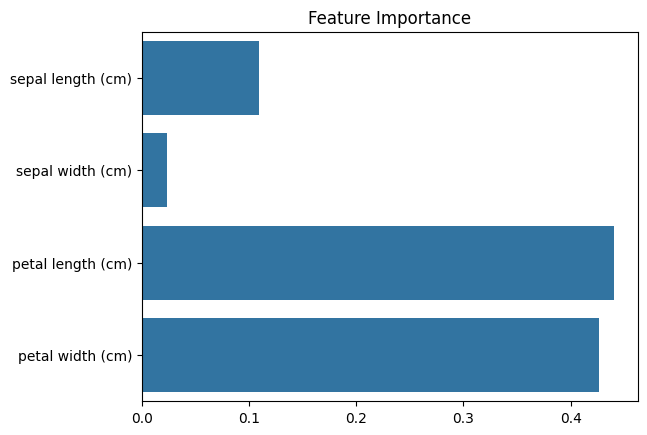
The impurity-based feature importance can be visualised as:
import seaborn as sns

sns.barplot(x=rf.feature_importances_, y=iris.feature_names)
plt.title("Feature Importance");
Boosting#
Boosting is an ensemble strategy that builds models sequentially, where each new tree focuses on correcting the errors made by the previous ones. In contrast to bagging and random forests, boosting does not train trees independently.
The core idea is to combine many weak learners (typically shallow trees) into a single strong predictive model:
Fit a simple tree to the data
Identify observations that are predicted poorly
Increase the influence (weight) of these observations
Fit a new tree that focuses more on the difficult cases
Repeat and combine all trees
Each individual tree is usually very small (often depth 1-3) and only slightly better than random guessing. The strength of boosting comes from accumulating many such small improvements. If we denote the \(m\)-th tree by \(T_m(x)\) and its fitted weight by \(\gamma_m\), the boosted prediction after \(M\) trees is typically
where the learning rate \(\eta\) shrinks each tree’s contribution. Because the trees are added sequentially, later trees are trained on the residuals (or gradient directions) left unexplained by the earlier ones.
Boosted trees involve several interacting hyperparameters:
Number of trees: more trees increase model capacity
Tree depth: shallow trees reduce variance and overfitting
Learning rate \(\eta\): controls how strongly each tree contributes
A common rule of thumb is to use a small learning rate and to compensate with more trees:
from sklearn.ensemble import GradientBoostingClassifier

boost = GradientBoostingClassifier(n_estimators=200,
                                   learning_rate=0.05,
                                   max_depth=2,
                                   random_state=42)
boost.fit(X_train, y_train)

accuracy_score(y_test, boost.predict(X_test))
0.96
Advantages
Often achieves very high predictive accuracy
Can model complex non-linear relationships
Strong performance using relatively small trees
Disadvantages
Sensitive to hyperparameter choices
Can overfit if trees are too deep or learning rate too large
Less interpretable than single trees
Summary#
Tree-based methods
Method |
Description |
Pros (non exhaustive) |
Cons (non exhaustive) |
|---|---|---|---|
Decision Trees |
Split data via feature thresholds |
Highly interpretable, fast to train |
High variance -> prone to overfitting |
Bagging |
Average many bootstrapped trees |
Reduces variance / overfitting |
Less interpretable; larger memory footprint |
Random Forest |
Bagging + random feature subsets at each split |
Further reduces variance; robust |
Slower to train and predict |
Boosting |
Sequentially fit to previous residuals / errors |
Low bias -> often very accurate |
Can overfit noisy data; sensitive to hyperparameters |